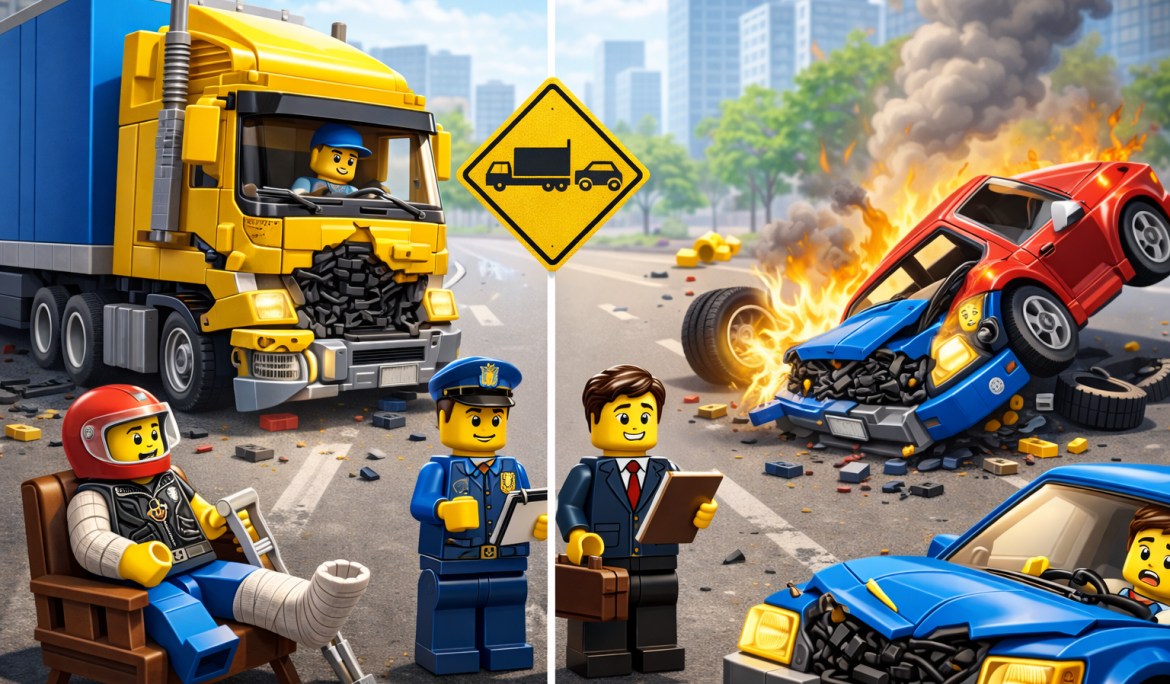
A truck accident vs car accident may appear to be simply a larger version of a standard vehicle collision. However, while a truck crash may look like a more serious car wreck because of the sheer size and weight involved, the legal process is far more complex. There are significantly more entities potentially liable in a truck accident vs car accident scenario. For this reason, it is essential to consult with a truck accident attorney who understands the nuances of commercial litigation and can properly navigate the complexities of commercial vehicle accidents.
The Sheer Scale of Devastation
Let’s begin with the undeniable reality. A fully loaded semi-truck can weigh up to 80,000 pounds. In contrast, the average passenger car weighs approximately 4,000 pounds. When these two vehicles collide, the laws of physics are brutal and unforgiving.
As a result, the injuries associated with truck wrecks are frequently catastrophic. These often include traumatic brain injuries, spinal cord damage, amputations, and other life-altering harm. Because of the massive weight disparity, victims typically face increased medical expenses, prolonged hospitalization, lost wages, and long-term care costs.
This dramatic imbalance in force is one of the most critical factors distinguishing a truck accident vs car accident case. The physical devastation alone often transforms a claim into high-stakes litigation.
The Complex Web of Truck Crash Liability
Perhaps the most significant legal difference in a truck accident vs car accident involves liability. In a typical car crash, responsibility is usually limited to the drivers involved. The legal question often centers on which driver acted negligently.
However, in a truck accident, liability rarely stops with the driver. Instead, a complex network of potentially responsible parties must be investigated and evaluated.
Potentially Liable Parties in Truck Accident Cases
The Truck Driver: Was the driver distracted, fatigued, speeding, or under the influence of drugs or alcohol?
The Trucking Company: Did the company fail to properly train or supervise the driver? Did they pressure the driver to violate safety regulations? Did they neglect necessary vehicle maintenance?
The Cargo Owner or Loader: Was the truck improperly loaded or overloaded, making it unstable and difficult to control?
The Maintenance Company: If a third-party maintenance provider handled repairs, did faulty workmanship lead to mechanical failure?
The Truck Manufacturer: Was there a design defect or faulty component, such as defective brakes or tires?
As you can see, identifying and pursuing claims against all potential defendants is a complex legal undertaking. This level of multi-party investigation rarely occurs in standard auto wrecks. In fact, the investigation into truck crash liability is often massive in scope and requires immediate, aggressive legal action.
A Different Set of Rules: Federal Regulations
Another major difference in a truck accident vs car accident lies in the regulatory framework. While car accidents are governed primarily by state traffic laws, commercial trucks are subject to extensive federal oversight.
Commercial carriers must comply with regulations enacted by the Federal Motor Carrier Safety Administration. These federal rules govern nearly every aspect of commercial motor vehicle operation.
Examples of Federal Trucking Regulations
Hours of Service (HOS) Rules: These regulations limit how many hours a driver may be on-duty or driving at one time in order to reduce fatigue-related crashes.
Maintenance and Inspection Requirements: Trucking companies must conduct periodic inspections, maintain vehicles properly, and keep detailed service records.
Driver Qualification Standards: Drivers must meet strict licensing, training, and medical certification requirements.
When these federal regulations are violated, such violations can serve as powerful evidence of negligence. An experienced attorney understands how to use regulatory non-compliance to strengthen a claim. This complex regulatory structure represents a fundamental distinction in the truck accident vs car accident comparison.
The Evidence Is Different in a Truck Accident vs Car Accident
Because commercial trucks operate under federal regulation, the evidence in a truck accident case is significantly more technical and detailed than in a typical car crash.
While a car accident investigation may rely on a police report and eyewitness accounts, truck accident litigation requires deep analysis of specialized records and electronic data.
Critical Evidence in Truck Accident Cases
The Truck’s Black Box (ECU): This electronic control unit records speed, braking patterns, throttle position, and other operational data leading up to the crash.
Driver Logs: These logs reveal whether the driver complied with hours-of-service regulations.
Maintenance and Inspection Records: These documents show whether the trucking company maintained the vehicle properly or cut corners on safety.
Cargo and Weight Manifests: These records indicate whether the truck was overloaded or improperly balanced.
Securing and analyzing this evidence requires immediate action. Preservation letters must be sent quickly to prevent the destruction or overwriting of critical data. Without swift legal intervention, vital evidence unique to commercial vehicle accidents can disappear.
The Insurance Battle Is Fiercer
Trucking companies are required to carry substantially higher insurance coverage than passenger vehicle drivers, often with policies worth millions of dollars. While this increases potential compensation for victims, it also means insurance carriers fight far more aggressively.
Immediately after a crash, trucking companies often deploy investigators and defense attorneys to begin building a case designed to minimize liability. They search for ways to shift blame onto the injured victim.
The insurance battle in a truck crash liability claim is not a routine negotiation. Instead, it is a high-stakes legal war. This aggressive dynamic further distinguishes a truck accident vs car accident case.
You Need a Specialist for Commercial Vehicle Accidents
When you consider the catastrophic injuries, the layered liability, the federal regulations, the unique evidence, and the aggressive insurance tactics, it becomes clear that a truck accident vs car accident case involves entirely different legal challenges.
You would not seek a foot doctor for brain surgery. Likewise, you should not rely on a general practice attorney to handle a truck wreck claim. You need a lawyer experienced in truck accident cases who understands federal regulations, commercial litigation strategy, and large-scale insurance defense tactics.
If you or a loved one has suffered injuries in a truck accident, do not assume it is simply another car crash. The legal landscape surrounding commercial vehicle accidents is far more complex and requires decisive action.
Contact Bad Accident Lawyer today for a free consultation to discuss the specifics of your case.
Frequently Asked Questions
Why is truck crash liability so much more complicated?
Truck crash liability is more complex because multiple parties may be responsible, including the trucking company, cargo loaders, maintenance providers, and equipment manufacturers. Additionally, each party may have separate insurance carriers, which significantly complicates litigation and settlement negotiations.
What is the most important piece of evidence in a truck accident case?
The truck’s black box data and the driver’s logs are often among the most critical pieces of evidence. These records can objectively demonstrate speeding, sudden braking, or violations of hours-of-service regulations that may indicate driver fatigue.
What is the main difference in a truck accident vs car accident investigation?
The primary difference lies in the scope of evidence and regulatory compliance review. Car accident investigations focus primarily on the drivers involved. Truck accident investigations also examine federal trucking regulations and company compliance documentation.
Are all lawyers qualified to handle a truck accident case?
No. Commercial vehicle accident litigation requires in-depth knowledge of federal trucking regulations and experience litigating against large corporate entities. It is critical to hire a law firm experienced specifically in truck accident litigation.
What is the time limit for filing a truck accident lawsuit?
The statute of limitations varies by state, typically ranging from one to four years. However, truck accident cases require immediate attention because critical evidence, including black box data and driver logs, can be destroyed or overwritten within days or weeks. Early legal action protects your rights and preserves essential evidence.