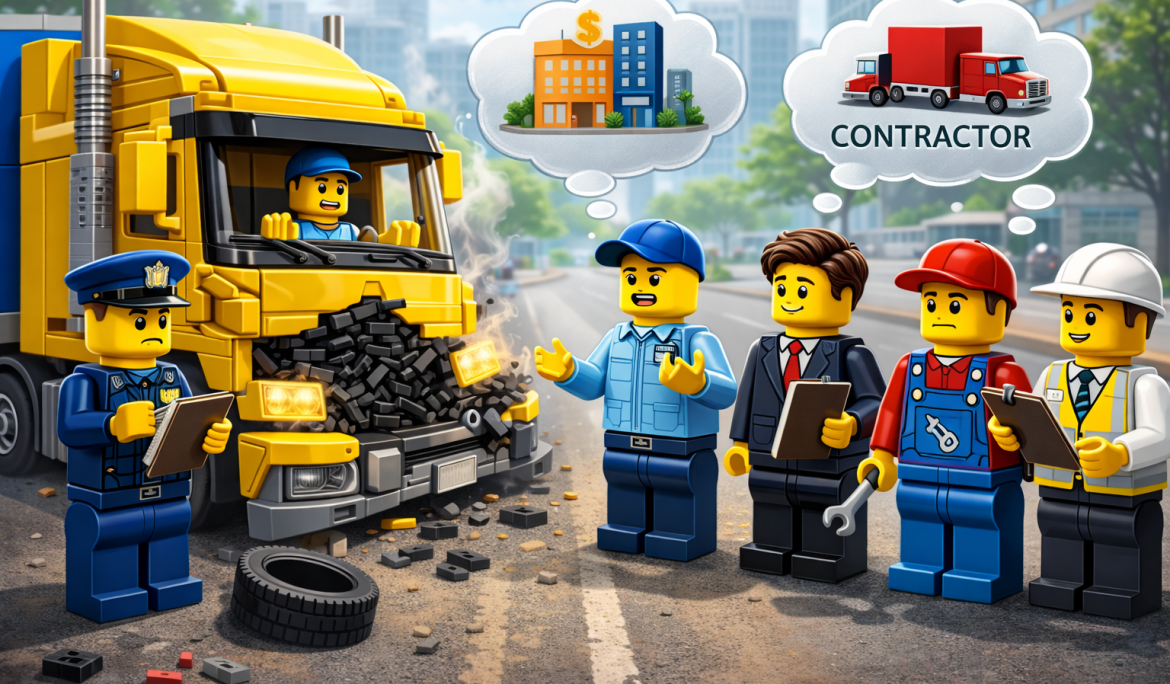
When a semi-truck weighing 80,000 pounds crashes into a smaller passenger vehicle, the consequences are almost always catastrophic. Determining truck accident liability is far more complex than most people realize. Many assume the truck driver is the only one to blame when a truck and a car collide. While the driver is often negligent, commercial truck accidents typically involve multiple responsible parties.
The number of parties involved can vary depending on the circumstances. There may be one, two, three, or even four additional entities whose actions contributed to the crash. A proper investigation begins at the scene of the wreck, where physical evidence is gathered. From there, investigators work systematically to uncover every layer of truck accident liability.
Once potential defendants are identified, each party’s role must be examined carefully. Determining who was negligent, and to what degree, requires extensive experience, detailed research, and strategic legal analysis. Insurance companies will rarely volunteer this information. Instead, it must be aggressively uncovered.
The Concept of Vicarious Liability
In commercial trucking, the driver is rarely the only party financially responsible. The legal doctrine known as respondeat superior plays a central role in establishing truck accident liability. This Latin phrase means “let the master answer,” and it holds employers responsible for the negligent actions of their employees when those actions occur within the scope of employment.
This principle forms the foundation of trucking company accountability. If a truck driver causes a crash while performing job duties, the employer can be held legally responsible for the damages. However, trucking company liability often extends beyond simple vicarious responsibility.
Unpacking Trucking Company Liability
A trucking company’s responsibility does not end when it hires a driver. Commercial carriers have a legal duty to ensure their drivers operate safely. When companies prioritize profit over safety, they create dangerous conditions on public roads.
Beyond vicarious liability, there are multiple ways a trucking company may directly contribute to truck accident liability.
Common Grounds for Direct Company Negligence
Negligent Hiring: Did the company hire a driver with a history of reckless driving, DUI convictions, or serious safety violations?
Inadequate Training: Was the driver properly trained to operate a commercial vehicle safely and comply with federal safety regulations?
Pressuring Drivers: Did the company push drivers to exceed hours-of-service limits to meet unrealistic deadlines, increasing fatigue-related crash risks?
When evidence shows a company ignored red flags or violated safety standards, proving trucking company liability becomes central to the case. An experienced truck accident lawyer knows where to locate employment files, training records, internal communications, and compliance documentation that expose corporate negligence.
Establishing these failures is often the key to proving full truck accident liability.
Other Parties in the Chain of Truck Accident Liability
Although the driver and trucking company are common defendants, they are not the only potential sources of liability. Commercial freight transportation involves numerous entities. Negligence at any point in that chain can trigger a devastating crash.
Cargo Loaders and Shippers
A truck’s balance and stability depend heavily on how cargo is loaded. If a third-party loading company improperly secures freight, the load may shift during transit. This can lead to jackknife accidents, rollovers, or loss of vehicle control. Overloaded trucks are especially dangerous because they require longer stopping distances and strain braking systems.
When improper loading contributes to a crash, the cargo company may share responsibility. In such cases, commercial truck accident fault extends beyond the driver and carrier.
Maintenance and Repair Shops
Many trucking companies outsource vehicle maintenance. If a repair shop fails to service brakes properly or neglects to inspect critical mechanical systems, that negligence may directly cause an accident.
Proving this type of truck accident liability requires careful analysis of maintenance logs, service invoices, and expert mechanical inspections. Skilled attorneys often work with engineering experts to demonstrate how mechanical failure occurred.
Truck and Parts Manufacturers
In certain cases, the crash stems from a defective product rather than human error. Tire blowouts, brake failures, or steering malfunctions caused by design or manufacturing defects can lead to catastrophic accidents.
When a defective component causes a collision, the manufacturer may face liability under product liability laws. These cases are highly technical and require detailed engineering analysis. This represents yet another layer of potential truck accident liability.
The Role of a Specialized Truck Accident Lawyer
Determining responsibility in a commercial truck accident is not straightforward. It is a complex legal puzzle involving corporate records, federal regulations, technical data, and aggressive insurance defense strategies.
A specialized truck accident lawyer understands how to move quickly. Preservation letters must be sent immediately to protect black box data, driver logs, and internal company records before they are altered or destroyed. Federal safety regulations must be reviewed carefully to uncover compliance violations.
Without swift and experienced legal intervention, critical evidence can disappear. Insurance companies know this. That is why they begin building their defense immediately after a crash.
Holding Everyone Accountable
Identifying every responsible party is not simply a legal technicality. It directly impacts the amount of compensation available to the injured victim.
When all liable parties are pursued, their combined insurance coverage becomes accessible. This increases the likelihood that victims can recover full compensation for medical expenses, lost wages, rehabilitation, and long-term suffering.
If you have been injured in a truck accident, do not assume the driver is the only one at fault. A comprehensive investigation into truck accident liability may reveal multiple responsible parties.
Contact Bad Accident Lawyer today for a free consultation to protect your rights and begin building your case.
Frequently Asked Questions
What is the most important factor in determining truck accident liability?
A thorough investigation is critical. These cases depend on quickly gathering and preserving evidence such as black box data, driver logs, and maintenance records before they are destroyed.
How is trucking company liability different from the driver’s liability?
The driver is responsible for direct negligent actions such as speeding. The trucking company can be liable both vicariously for the driver’s conduct and directly for its own negligence, including poor hiring, inadequate training, or maintenance failures.
Can a truck driver be an independent contractor?
Sometimes. However, companies frequently misclassify drivers to avoid responsibility. Courts often examine the level of control the company exercised over the driver when determining truck accident liability.
What is a commercial truck accident fault investigation like?
It begins with preservation letters and evidence collection. Accident reconstruction experts analyze the crash scene, download electronic truck data, and review thousands of pages of corporate safety and compliance records to identify regulatory violations.
Why do I need a lawyer who specializes in truck accidents?
These cases involve federal safety regulations and layered corporate liability structures that do not exist in standard car accidents. A specialized attorney has the experience and resources to take on large trucking and insurance corporations effectively.